Auditorium (AE 005), Department of Aerospace Engineering

  1. Events
  2. Venues
  3. Auditorium (AE 005), Department of Aerospace Engineering
Events at this venue
Today

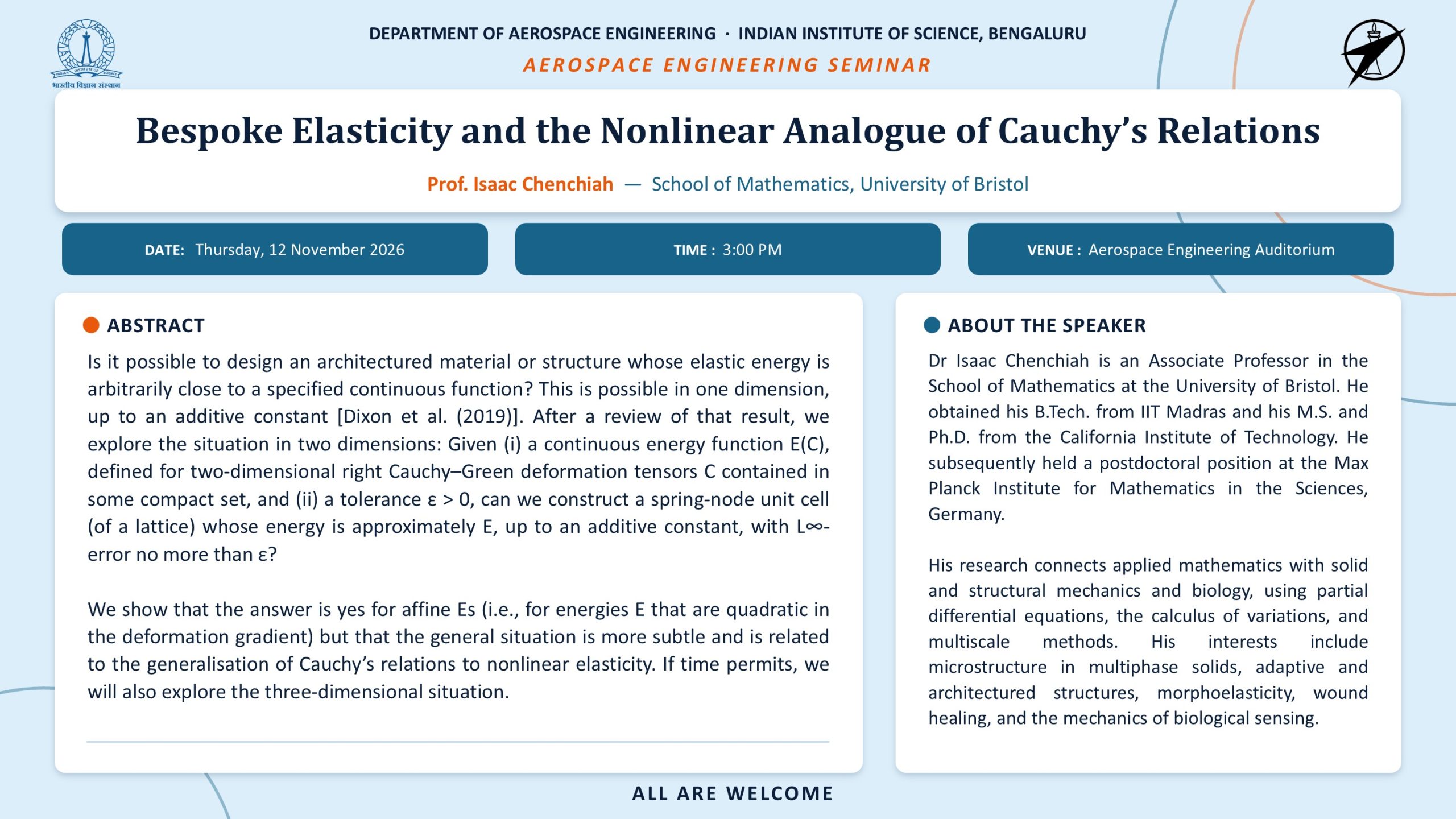
Bespoke Elasticity and the Nonlinear Analogue of Cauchy’s Relations 

Auditorium (AE 005), Department of Aerospace Engineering

Is it possible to design an architectured material or structure whose elastic energy is arbitrarily close to a specified continuous function? This is possible in one dimension, up to an additive constant . After a review of that result, we explore the situation in two dimensions: Given (i) a continuous energy function E(C), defined for […]
Linear instabilities in modulated Taylor-Couette flows”

Auditorium (AE 005), Department of Aerospace Engineering

The modulated Taylor-Couette flow takes place in the annular gap between two concentric cylinders, assumed of infinite extent in the axial direction. Inner and outer cylinders rotate about their common axis with two independent rotation rates that are periodically modulated in time. While there exists a significant literature on the time-periodic Taylor-Couette configuration, many investigations […]

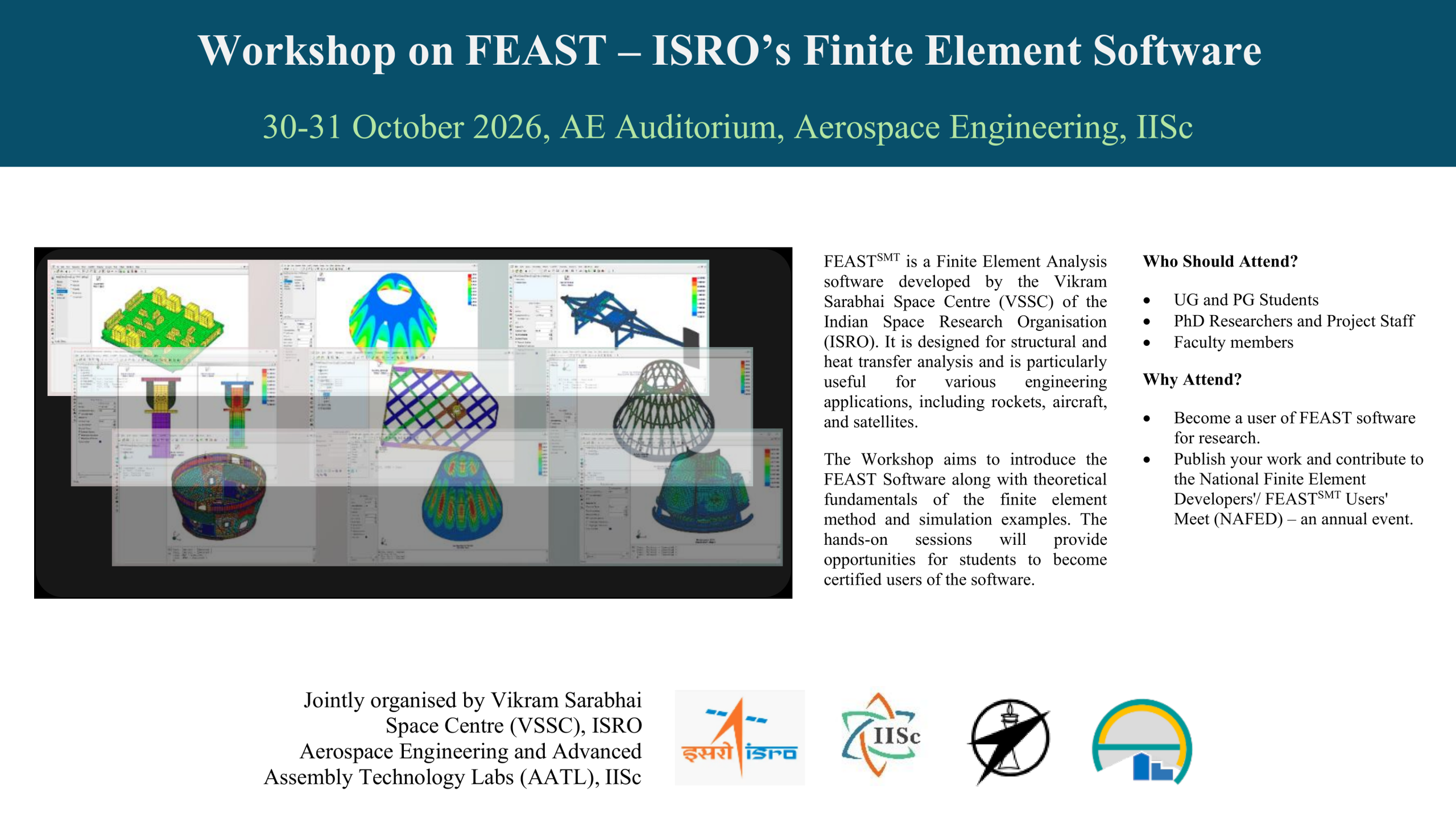
Workshop on FEAST – ISRO’s Finite Element Analysis Software

Auditorium (AE 005), Department of Aerospace Engineering

We welcome all interested participants to join a two-day hands-on Workshop on FEAST - ISRO's Finite Element Analysis Software 30-31 Oct 2026, AE Auditorium Speakers: Team of Senior Scientists, Software Development Team, VSSC, ISRO Day1 Starts at 8:45am. Flyer with Program Schedule is Attached. Registration is mandatory. Please fill in the registration form using the […]

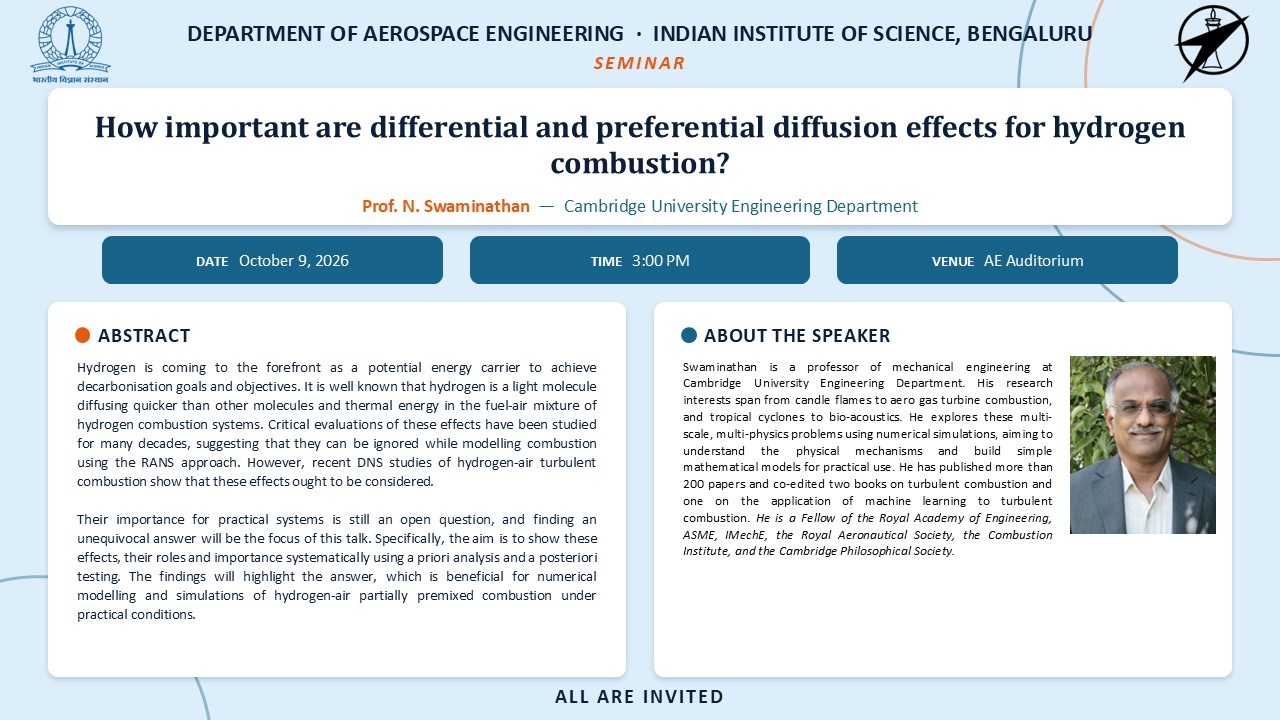
How important are differential and preferential diffusion effects for hydrogen combustion?

Auditorium (AE 005), Department of Aerospace Engineering

Hydrogen is coming to the forefront as a potential energy carrier to achieve decarbonisation goals and objectives. It is well known that hydrogen is a light molecule diffusing quicker than other molecules and thermal energy in the fuel-air mixture of hydrogen combustion systems. Critical evaluations of these effects have been studied for many decades, suggesting […]

Illuminating Complex Flows: Optical Diagnostics for Aerospace Applications

Auditorium (AE 005), Department of Aerospace Engineering

Hypersonic flight represents a major frontier in aerospace engineering, with its realization requiring a fundamental understanding of coupled chemical and fluid dynamic processes across multiple environments. Of particular importance are the reacting flows within the propulsion systems that enable sustained hypersonic flight and the high-temperature, chemically reacting flows that develop near vehicle surfaces at extreme […]

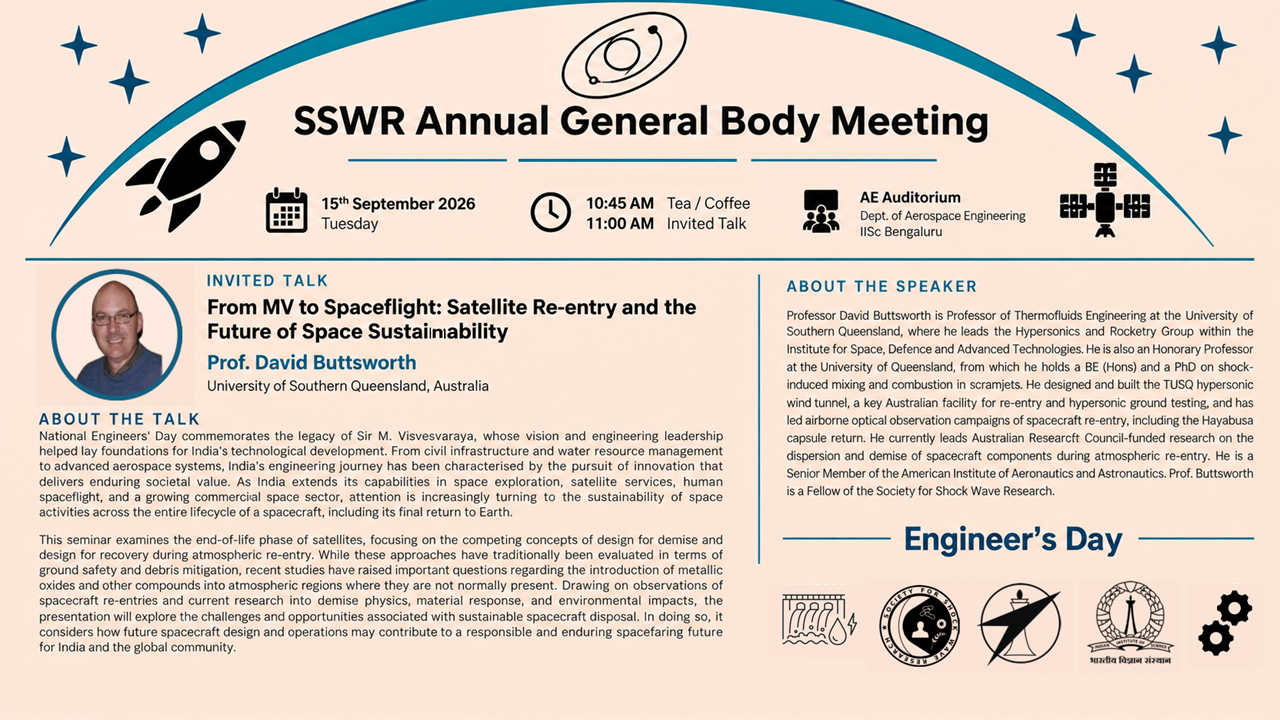
Invited Talk on the Occasion of the Engineer’s Day – From MV to Spaceflight: Satellite Re-entry and the Future of Space Sustainability

Auditorium (AE 005), Department of Aerospace Engineering

National Engineers' Day commemorates the legacy of Sir M. Visvesvaraya, whose vision and engineering leadership helped lay foundations for India's technological development. From civil infrastructure and water resource management to advanced aerospace systems, India's engineering journey has been characterised by the pursuit of innovation that delivers enduring societal value. As India extends its capabilities in […]

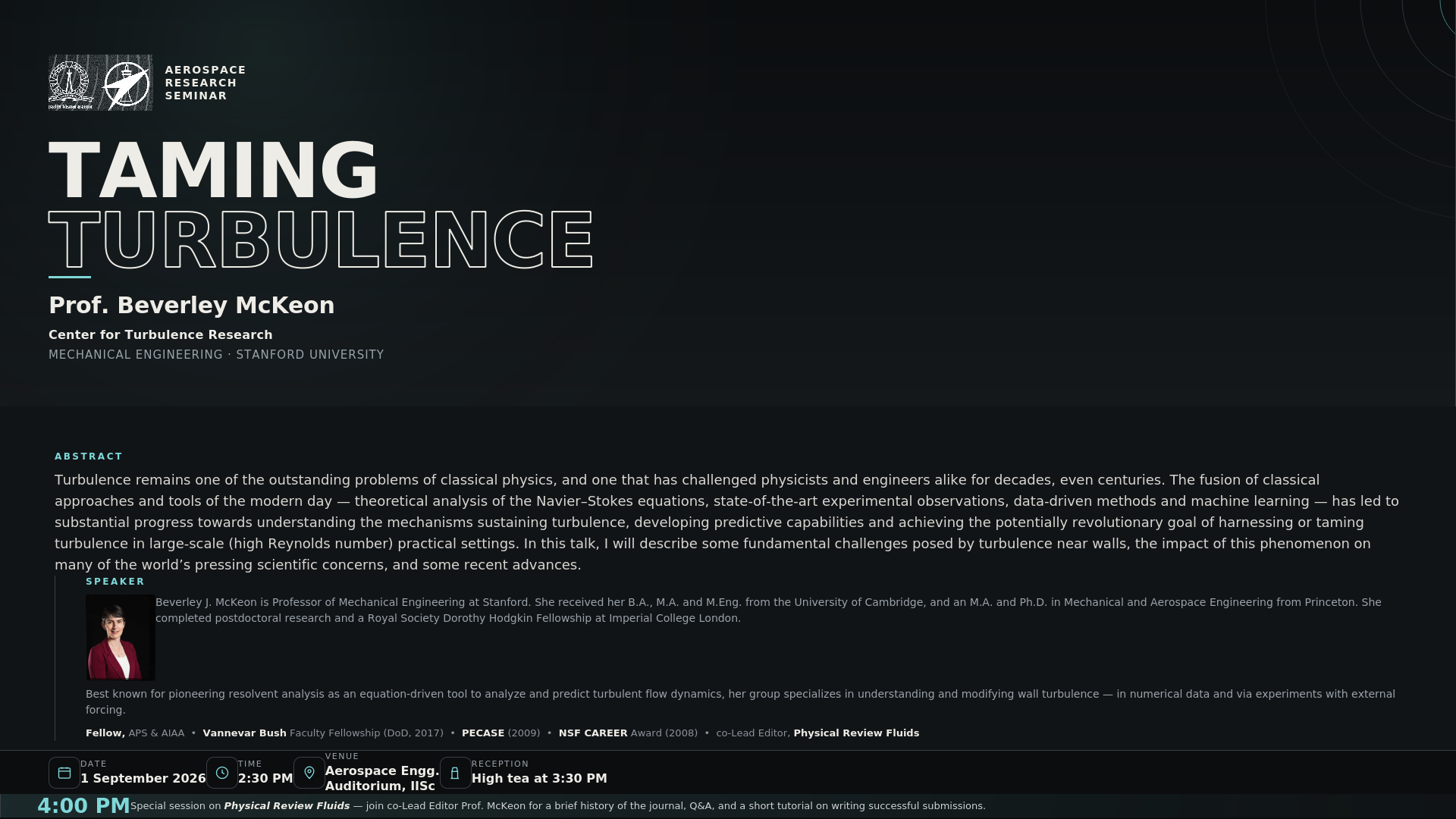
Taming Turbulence

Auditorium (AE 005), Department of Aerospace Engineering

Turbulence remains one of the outstanding problems of classical physics, and one that has challenged physicists and engineers alike for decades, even centuries. The fusion of classical approaches and tools of the modern day – theoretical analysis of the Navier-Stokes equations, state-of-the-art experimental observations, data-driven methods and machine learning – has led to substantial progress […]

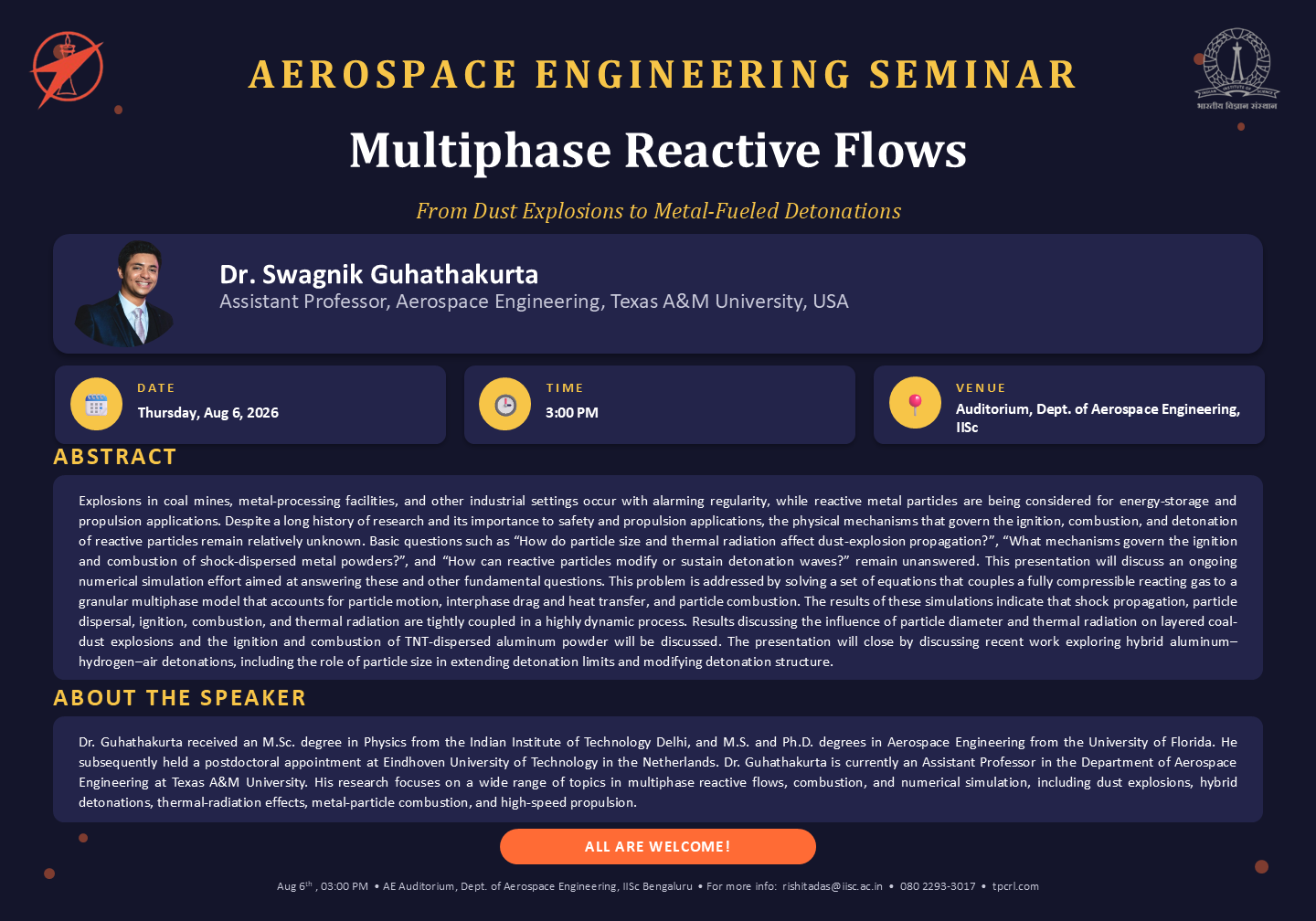
Multiphase Reactive Flows: From Dust Explosions to Metal-Fueled Detonations

Auditorium (AE 005), Department of Aerospace Engineering

. Explosions in coal mines, metal-processing facilities, and other industrial settings occur with alarming regularity, while reactive metal particles are being considered for energy-storage and propulsion applications. Despite a long history of research and its importance to safety and propulsion applications, the physical mechanisms that govern the ignition, combustion, and detonation of reactive particles remain […]

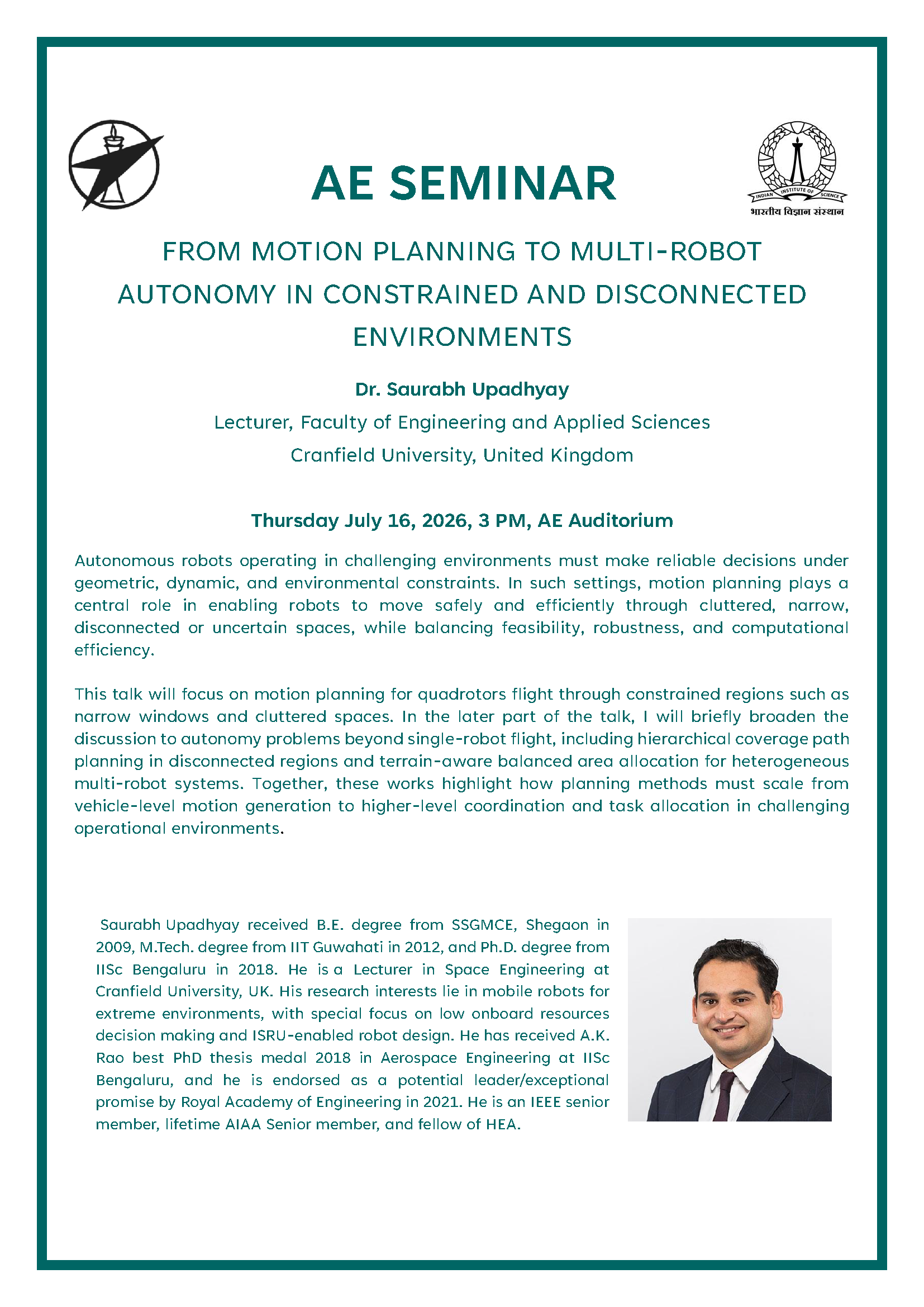
FROM MOTION PLANNING TO MULTI-ROBOT AUTONOMY IN CONSTRAINED AND DISCONNECTED ENVIRONMENTS

Auditorium (AE 005), Department of Aerospace Engineering

Autonomous robots operating in challenging environments must make reliable decisions under geometric, dynamic, and environmental constraints. In such settings, motion planning plays a central role in enabling robots to move safely and efficiently through cluttered, narrow, disconnected or uncertain spaces, while balancing feasibility, robustness, and computational efficiency. This talk will focus on motion planning for […]

Workshop on “Signal Processing for High-Precision Navigation and Surveillance”

Auditorium (AE 005), Department of Aerospace Engineering

Dear All, The Dept. of Aerospace Engineering, in collaboration with Centre for Continuing Education is conducting a one-week tutorial workshop on "Signal Processing for High-Precision Navigation and Surveillance", during 06 – 11 July 2026. Based on some requests, the due date of Early Registration has been extended to 28-06-2026 (Sunday). More details can be found […]

From Pilot Workload to Adverse Couplings: Understanding Human–Vehicle Interactions in Challenging Rotorcraft Operations

Auditorium (AE 005), Department of Aerospace Engineering

As civil and military aircraft evolve toward increasingly complex designs and intelligent systems, understanding pilot–vehicle interactions and their impact on safety and performance remains essential. Rotorcraft shipboard landing is among the most demanding flight operations, requiring pilots to contend with degraded and rapidly changing visual cues, deck motion, and environmental disturbances, often resulting in elevated […]

AE Seminar by Dr Sri Prakash Sarathy, Northrop Grumman

Auditorium (AE 005), Department of Aerospace Engineering

AI in general and Agentic AI Frameworks in particular have begun to appear in safety critical and mission critical application of autonomous systems. Assurance of their behavior lags behind in terms of principles, tools and engineering practice. In this presentation I will cover some emerging approaches that are both powerful and practical, and easily understood […]

Scroll to Top