STC Seminar Hall, Dept. of Aerospace Engineering

  1. Events
  2. Venues
  3. STC Seminar Hall, Dept. of Aerospace Engineering
Events at this venue
Today

Ph.D. (Engg): Splashing of impacting drops on rigid and flexible superhydrophobic surfaces

STC Seminar Hall, Dept. of Aerospace Engineering

Understanding droplet impact dynamics on superhydrophobic (SHP) surfaces is crucial for exploiting their exceptional liquid-repellent properties in various industrial applications. Studies on high-velocity droplet impacts on SHP surfaces, particularly under splashing conditions, are of significant importance for applications such as anti-icing and erosion protection of turbine blades. This thesis presents an experimental investigation of splashing […]
Ph.D. (Engg): Development of Learning-based Strategies for Reconnaissance with Multi-Robot Systems

STC Seminar Hall, Dept. of Aerospace Engineering
Virtual Event Virtual Event

Reconnaissance is the contest for information about a territory: one side tries to observe an asset or a guarded area, the other tries to deny it. Low-cost drones have made this contest cheap and constant, and protecting critical infrastructure against it is now a crucial problem, because an intruder no longer needs to strike a […]

Ph.D. (Engg):Effect of rotation on the flow organisation and instability of a slender spinning body across quiescent, axial and compressible regimes

STC Seminar Hall, Dept. of Aerospace Engineering
Virtual Event Virtual Event

A body of revolution spinning in a fluid drives an inherently three-dimensional boundary layer, in which a centrifugally driven secondary circulation lifts the layer off the surface and a centrifugal instability carries it into transition. Most of what is known about this flow comes from single geometries (the rotating disk, the isolated cone or cylinder) […]

MTech(res) Parallel Particle Tracking for Turbulent Round Jets

STC Seminar Hall, Dept. of Aerospace Engineering

Particle tracking in turbulent jets is essential for an accurate Lagrangian understanding of jet flows. While parallel algorithms and numerical schemes to compute flow fields can be scaled to a large number of computing processes, the same is not necessarily true for particle tracking. This thesis presents an analysis of the parallel efficiency of particle […]

Ph.D. (Engg):Tonal acoustic radiation from turbulent subsonic jets

STC Seminar Hall, Dept. of Aerospace Engineering

Acoustic tones in the near field of a Mach 0.9, Reynolds number 10^6 round jet are investigated using large-eddy simulations (LES) performed with the explicit filtering LES (EFLES) approach. The jet is issued into the ambient through a cylindrical nozzle. Pressure spectra at observer locations in the upstream direction reveal the presence of tones which […]

Ph .D.(Engg.): Explicit Filtering LES of turbulent swirling flows and multi-regime hydrogen flames

STC Seminar Hall, Dept. of Aerospace Engineering

The need to decarbonize power generation and aviation has established hydrogen as a promising fuel for next generation gas turbine combustion systems. However, its high chemical reactivity significantly increases the propensity for autoignition and flashback under lean premixed conditions commonly used in hydrocarbon combustion systems. New combustor concepts based on direct fuel injection address these […]

AstroNav: Autonomy for Navigating Deep Space and Beyond

STC Seminar Hall, Dept. of Aerospace Engineering

Autonomous navigation is becoming a critical capability for modern deep space exploration, planetary defense, and commercial space ventures. Traditional spacecraft navigation relies heavily on ground-based radio contact to collect two-way radiometric Doppler and range measurements. However, this structural dependency introduces significant communication latency and places a heavy burden on oversubscribed ground antenna networks. For cutting-edge […]

Modelling the response of Turbulent CH4-Air premixed flame using Resolvent Analysis

STC Seminar Hall, Dept. of Aerospace Engineering

An understanding of the flame transfer function (FTF) is essential for predicting the onset of combustion instabilities in gas turbine combustors, where flow oscillations excited by acoustic forcing drive burning area and heat-release oscillations that can couple unfavourably with combustor acoustic modes. The heatrelease response is expensive to characterize directly through time resolved simulation, motivating […]

Ph.D. (Engg) : Distributed Artificial Intelligence Technology for Robotic Swarms: An Interpretable Online Learning Perspective

STC Seminar Hall, Dept. of Aerospace Engineering
Virtual Event Virtual Event

Robotic swarms offer immense potential for critical operations such as search and rescue, surveillance, and environmental monitoring, owing to their distributed nature and redundancy. However, the operational reliability of swarms heavily depends on a continuous, closed-loop process: extracting high-fidelity or accurate collective situational awareness from distributed observation, and subsequently utilizing that awareness for cooperative decision […]

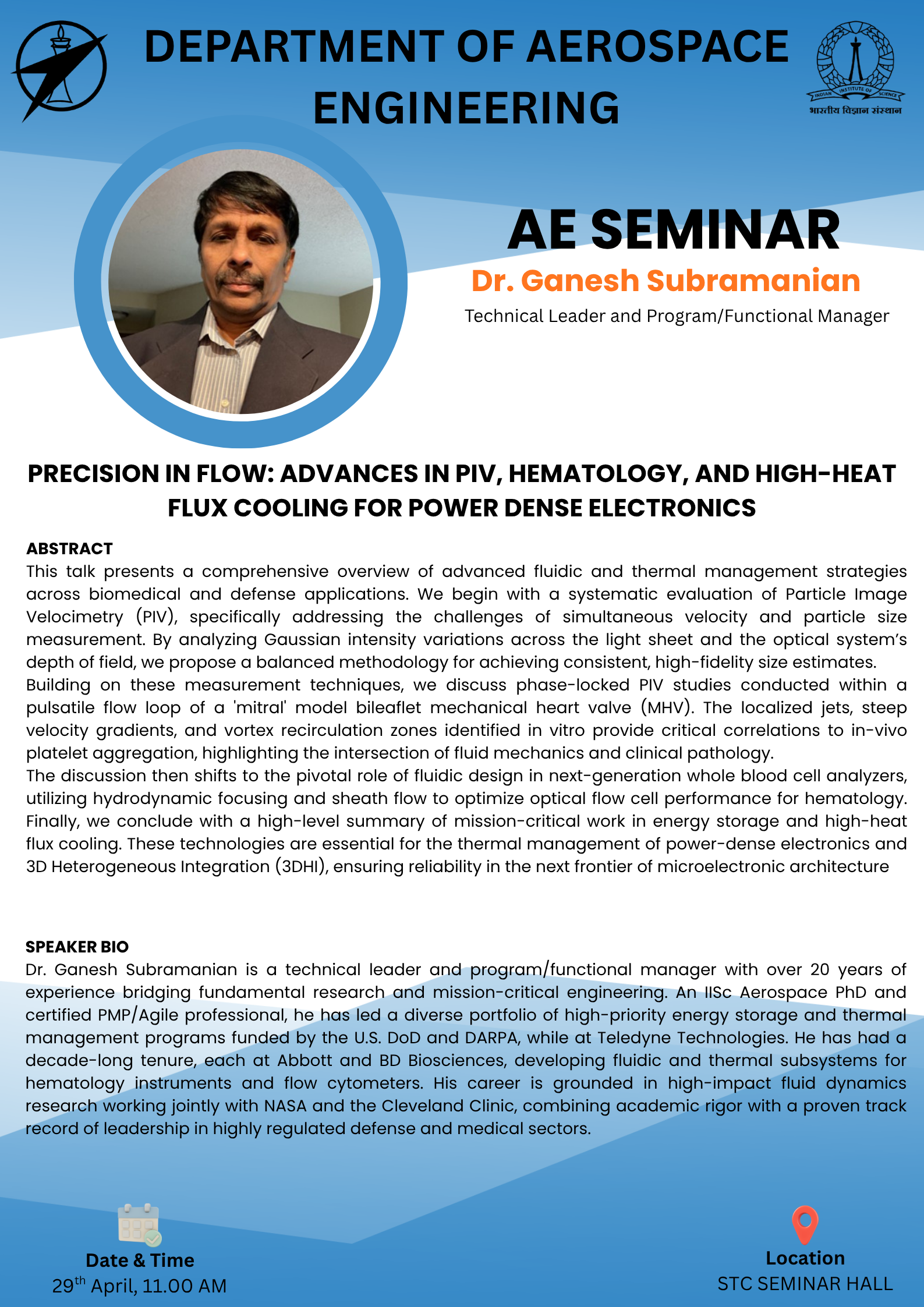
Precision in Flow: Advances in PIV, Hematology, and High-Heat Flux Cooling for Power Dense Electronics

STC Seminar Hall, Dept. of Aerospace Engineering

This talk presents a comprehensive overview of advanced fluidic and thermal management strategies across biomedical and defense applications. We begin with a systematic evaluation of Particle Image Velocimetry (PIV), specifically addressing the challenges of simultaneous velocity and particle size measurement. By analyzing Gaussian intensity variations across the light sheet and the optical system’s depth of […]

M.Tech(Res) : Effect of hydrogen-enrichment on soot formation in laminar gaseous hydrocarbon flames

STC Seminar Hall, Dept. of Aerospace Engineering

Gaseous and particulate pollutants pose a significant threat to human health and the environment, prompting regulatory action to address major sources of emissions. Soot is a key particulate pollutant. Recently, emission standards for commercial aeroengines have been revised, necessitating the mitigation of soot emissions. Investigating the soot formation process is a key step towards reducing […]

Ph.D. (Engg) :Experimental Investigation of Autoignition Pathways and Shock-Train Dynamics During Mode Transition in a Dual-Mode Supersonic Cavity Combustor

STC Seminar Hall, Dept. of Aerospace Engineering

Hypersonic propulsion systems capable of sustained atmospheric flight are critical enablers for future reusable launch vehicles, long-range high-speed transport, and responsive global strike platforms. Among the various air-breathing concepts, scramjet engines offer unmatched efficiency at hypersonic speeds by utilizing atmospheric oxygen and avoiding the mass penalties associated with onboard oxidizers. However, the practical realization of […]

Scroll to Top