Views Navigation

Event Views Navigation

Today

Data-driven learning of feedback policies for robust model predictive control: An approximation-theoretic view

Auditorium (AE 005), Department of Aerospace Engineering

Model Predictive Control (MPC) is a widely used optimization-based framework for the synthesis of feedback control, with mature theory and practice in the linear setting. Yet computational tractability remains a key bottleneck—particularly for robust nonlinear min-max MPC—because solving a (robust) optimization problem at every step is expensive and often intractable in practice. Explicit or approximate MPC […]
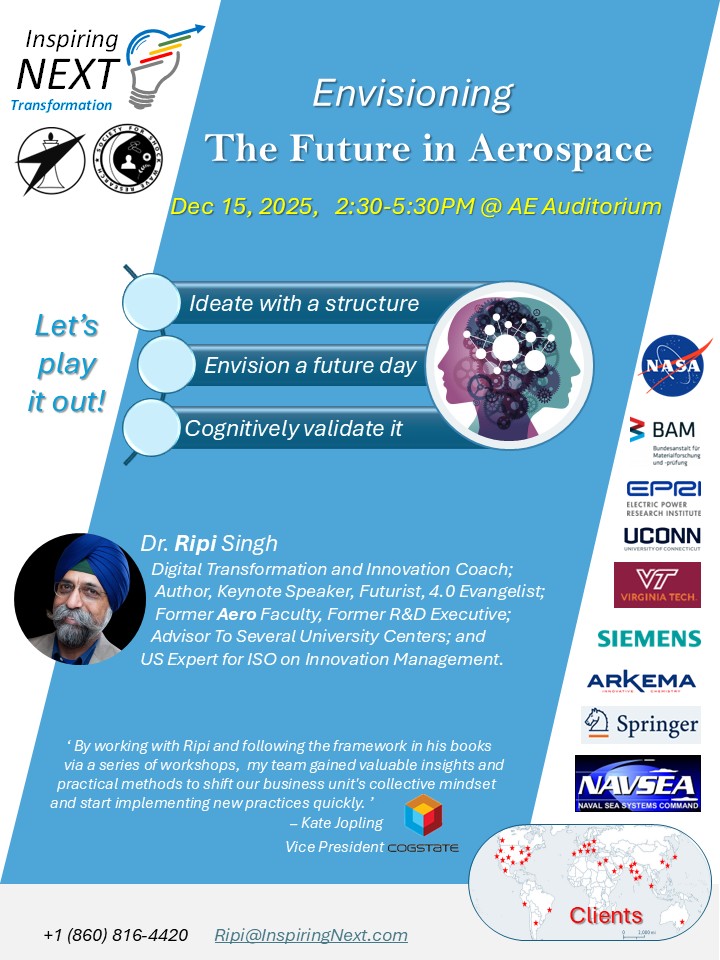
Workshop on Ideation: Envisioning :The Future in Aerospace

Auditorium (AE 005), Department of Aerospace Engineering

SSWR, Department of Aerospace Engineering, is organizing a workshop on Ideation. Resource Person: Dr. Ripi Singh Digital Transformation and Innovation Coach; Author, Keynote Speaker, Futurist, 4.0 Evangelist; Former Aero Faculty, Former R&D Executive; Advisor To Several University Centers; and US Expert for ISO on Innovation Management.

Ph.D. (Engg) : Investigations on Elastic Deformation of Ferromagnetic Rods and Ribbons

STC Seminar Hall, Dept. of Aerospace Engineering

Bulk ferromagnetic materials exhibit Joule magnetostriction with characteristic strain magnitudes on the order of (10^{-6}) to (10^{-4}), which is often insufficient for the displacement requirements of modern soft robotic and adaptive structural systems. Ferromagnetic elastic slender structures provide a promising alternative, offering the potential for large actuation displacements under small external magnetic fields. This enhanced […]

Ph.D. (Engg) : Characterization of time-frequency behavior of flow intermittency in transitional boundary layers

STC Seminar Hall, Dept. of Aerospace Engineering

The importance of transitional flow studies can be realized from the fact that it acts as a bridge between the laminar and turbulent flows. The present work deals with the investigation of time-frequency characteristics of transitional flows and their modelling, which is presented in three parts. First, we propose a wavelet-transform based smooth detector function […]

Digital Process Twins for Automated Manufacturing of Thermoplastic Composites: Challenges and Opportunities.

Auditorium (AE 005), Department of Aerospace Engineering

Automated Fiber Placement (AFP) is transforming the fabrication of high-performance thermoplastic composites by enabling precision layup of fiber tows with spatially controlled heating and compaction. Yet, the interplay of radiative heating, heat diffusion, and material flow during AFP remains one of the least understood links between process parameters and structural performance. This seminar presents a […]

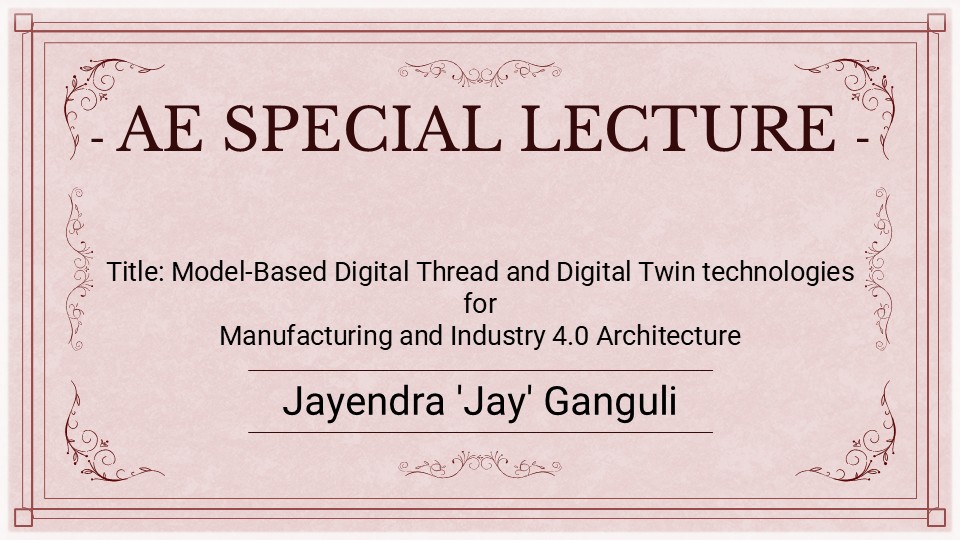
Model-Based Digital Thread and Digital Twin technologies for Manufacturing and Industry 4.0 Architecture

Auditorium (AE 005), Department of Aerospace Engineering

Jayendra 'Jay' Ganguli ,  is the Associate Director at Pratt & Whitney / RTX, leading initiatives in Model-Based Digital Thread and Digital Twin technologies for Manufacturing and Industry 4.0 Architecture. With over 30 years of experience in the Aerospace and Defense industry, his career spans leadership roles at GE Aviation, Boeing (Space and Commercial Aviation), […]

Ph.D. (Engg) : Enhancing Precise Label Prediction and Imbalance Robustness in Multi-Label Learning

STC Seminar Hall, Dept. of Aerospace Engineering

Multi-label learning (MLL) addresses learning problems in which a single data instance may simultaneously belong to multiple semantic categories. This formulation arises naturally in many real-world applications, including image and video understanding, medical diagnosis, text categorization, and bioinformatics. In many of these settings, it is not sufficient to merely rank relevant labels higher than irrelevant […]

Ph.D. (Engg) :Studies on the Mixing Layer Between Supersonic Supersonic Co-flows

STC Seminar Hall, Dept. of Aerospace Engineering

Two supersonic streams merging together in a co-flow configuration are encountered in several engineering systems, such as high-speed propulsion devices and supersonic ejectors. The thin mixing layer that develops between the two streams is dominated by compressibility effects and is prone to shock interactions in shock-dominated flows. The convective Mach number is defined relative to […]

Constructive Role of Noise in Oscillator Networks

Auditorium (AE 005), Department of Aerospace Engineering

he constructive role of temporal disorder (random noise) in facilitating responses of nonlinear systems will be explored in this talk, through a combination of experimental and numerical investigations. In particular, nonlinear oscillators and nonlinear oscillator arrays will be considered. These oscillator systems represent models of micro-scale and macro-scale systems and energy harvester systems. It is […]

Ph.D. (Engg) : Compression & LVI of closed-cell metallic foam

STC Seminar Hall, Dept. of Aerospace Engineering
Virtual Event Virtual Event

Innovative high-performance structural designs play a critical role in mitigating insecure events such as low-velocity and ballistic impacts. These events involve significant kinetic energies, requiring structures that are lightweight, safe, and capable of absorbing energy effectively. Closed cell metallic foams have been widely adopted in aerospace, marine, civil, mechanical, and automotive industries due to their […]

Ph.D. (Engg) : Development of an ultra-miniature wall-shear-stress sensor

Shear stress at the wall is a quantity of fundamental importance in wall-bounded flows. It determines skin-friction drag and the dynamics of flow separation. From an engineering standpoint, it is a key parameter which dictates the overall aerodynamic performance and structural loading of flight vehicles. Hence, there is a natural motivation for the development of […]

Ph.D. (Engg) : Turbulence Energy Cascade in Physical Space in a Turbulent Channel Flow

STC Seminar Hall, Dept. of Aerospace Engineering

A comprehensive investigation of the energy and enstrophy cascade in physical space in a turbulent channel flow is presented for four Reynolds numbers. Bandpass filtering techniques are employed to isolate scales and quantify inter-scale interactions through kinetic energy flux, enstrophy generation, and enstrophy flux. Two bandpass filter formulations used in the literature are quantitatively assessed by comparing the output. The mean energy and enstrophy cascades are shown to be predominantly local for all the Reynolds numbers. Away […]

Scroll to Top