Views Navigation

Event Views Navigation

Today

AE Seminar by Dr Sri Prakash Sarathy, Northrop Grumman

Auditorium (AE 005), Department of Aerospace Engineering

AI in general and Agentic AI Frameworks in particular have begun to appear in safety critical and mission critical application of autonomous systems. Assurance of their behavior lags behind in terms of principles, tools and engineering practice. In this presentation I will cover some emerging approaches that are both powerful and practical, and easily understood […]

From Pilot Workload to Adverse Couplings: Understanding Human–Vehicle Interactions in Challenging Rotorcraft Operations

Auditorium (AE 005), Department of Aerospace Engineering

As civil and military aircraft evolve toward increasingly complex designs and intelligent systems, understanding pilot–vehicle interactions and their impact on safety and performance remains essential. Rotorcraft shipboard landing is among the most demanding flight operations, requiring pilots to contend with degraded and rapidly changing visual cues, deck motion, and environmental disturbances, often resulting in elevated […]

MTech(Res): Characterization of Turbulent Spots near the onset of Transition in a Flat-plate Boundary Layer

Boundary layer (BL) transition to turbulence occurs through the inception, growth, and merging of turbulent spots. Understanding these spots is vital for predicting aerodynamic performance in disturbance-dominated environments like gas turbines. However, conventional spot identification has been limited by subjective, manual thresholding. The first phase of this work introduces a novel, threshold-free demarcation scheme combining […]

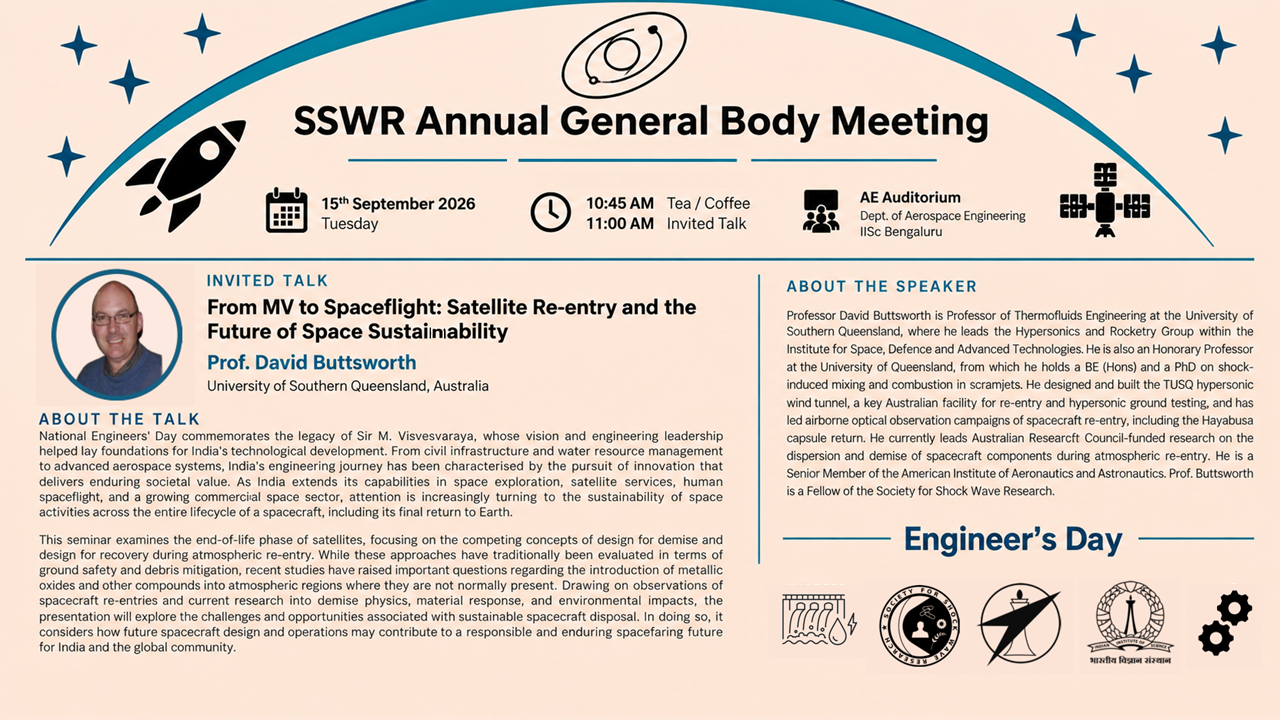
Workshop on “Signal Processing for High-Precision Navigation and Surveillance”

Auditorium (AE 005), Department of Aerospace Engineering

Dear All, The Dept. of Aerospace Engineering, in collaboration with Centre for Continuing Education is conducting a one-week tutorial workshop on "Signal Processing for High-Precision Navigation and Surveillance", during 06 – 11 July 2026. Based on some requests, the due date of Early Registration has been extended to 28-06-2026 (Sunday). More details can be found […]

Characterizing Dynamic Response of Structures and Materials under Extreme Loading Environments

Online
Virtual Event Virtual Event

Protective structures and vessels used in marine and defense applications are increasingly required to withstand extreme dynamic loading caused by explosions in air and underwater. Designing lightweight yet resilient structures demands a fundamental understanding of shock-wave interactions with materials, structural geometry, and the surrounding medium. This seminar presents a series of experimental investigations that progressively […]

FROM MOTION PLANNING TO MULTI-ROBOT AUTONOMY IN CONSTRAINED AND DISCONNECTED ENVIRONMENTS

Auditorium (AE 005), Department of Aerospace Engineering

Autonomous robots operating in challenging environments must make reliable decisions under geometric, dynamic, and environmental constraints. In such settings, motion planning plays a central role in enabling robots to move safely and efficiently through cluttered, narrow, disconnected or uncertain spaces, while balancing feasibility, robustness, and computational efficiency. This talk will focus on motion planning for […]

Modelling the response of Turbulent CH4-Air premixed flame using Resolvent Analysis

STC Seminar Hall, Dept. of Aerospace Engineering

An understanding of the flame transfer function (FTF) is essential for predicting the onset of combustion instabilities in gas turbine combustors, where flow oscillations excited by acoustic forcing drive burning area and heat-release oscillations that can couple unfavourably with combustor acoustic modes. The heatrelease response is expensive to characterize directly through time resolved simulation, motivating […]

Ph.D. (Engg) : Wave Propagation in Small Scale Structure Modelled With Nonlocal Continuum Theory

This thesis develops analytical and computational frameworks for studying static and dynamic behaviour in nonlocal elastic structures, focusing on wave propagation, stress localization, and guided-wave phenomena at micro- and nano-scales, where size-dependent effects fall outside classical continuum mechanics. Eringen's differential nonlocal elasticity theory and higher-order continuum formulations are used to capture these small-scale interactions. The […]

AstroNav: Autonomy for Navigating Deep Space and Beyond

STC Seminar Hall, Dept. of Aerospace Engineering

Autonomous navigation is becoming a critical capability for modern deep space exploration, planetary defense, and commercial space ventures. Traditional spacecraft navigation relies heavily on ground-based radio contact to collect two-way radiometric Doppler and range measurements. However, this structural dependency introduces significant communication latency and places a heavy burden on oversubscribed ground antenna networks. For cutting-edge […]

Multiphase Reactive Flows: From Dust Explosions to Metal-Fueled Detonations

Auditorium (AE 005), Department of Aerospace Engineering

. Explosions in coal mines, metal-processing facilities, and other industrial settings occur with alarming regularity, while reactive metal particles are being considered for energy-storage and propulsion applications. Despite a long history of research and its importance to safety and propulsion applications, the physical mechanisms that govern the ignition, combustion, and detonation of reactive particles remain […]

MTech(Res) : Design of an Ex-Situ Gas Sampling Layout with Various Probes and Their Performance Assessment for Accurate Emission Measurements

STC Conference Hall, Ground Floor, Department of Aerospace Engineering

Chemical kinetic mechanism development and validation require quantitative species data from canonical flames. Burner-stabilized pre -mixed flames provide a stationary post-flame region directly comparable to one-dimensional kinetic simulations. Ex-situ gas sampling delivers absolute CO and NO mole fractions from this region. The extraction step introduces two coupled biases. Reactions can continue inside the probe, and […]

Ph .D.(Engg.): Explicit Filtering LES of turbulent swirling flows and multi-regime hydrogen flames

STC Seminar Hall, Dept. of Aerospace Engineering

The need to decarbonize power generation and aviation has established hydrogen as a promising fuel for next generation gas turbine combustion systems. However, its high chemical reactivity significantly increases the propensity for autoignition and flashback under lean premixed conditions commonly used in hydrocarbon combustion systems. New combustor concepts based on direct fuel injection address these […]

Scroll to Top