Views Navigation

Event Views Navigation

Today

Ph.D. (Engg):Effect of rotation on the flow organisation and instability of a slender spinning body across quiescent, axial and compressible regimes

STC Seminar Hall, Dept. of Aerospace Engineering
Virtual Event Virtual Event

A body of revolution spinning in a fluid drives an inherently three-dimensional boundary layer, in which a centrifugally driven secondary circulation lifts the layer off the surface and a centrifugal instability carries it into transition. Most of what is known about this flow comes from single geometries (the rotating disk, the isolated cone or cylinder) […]
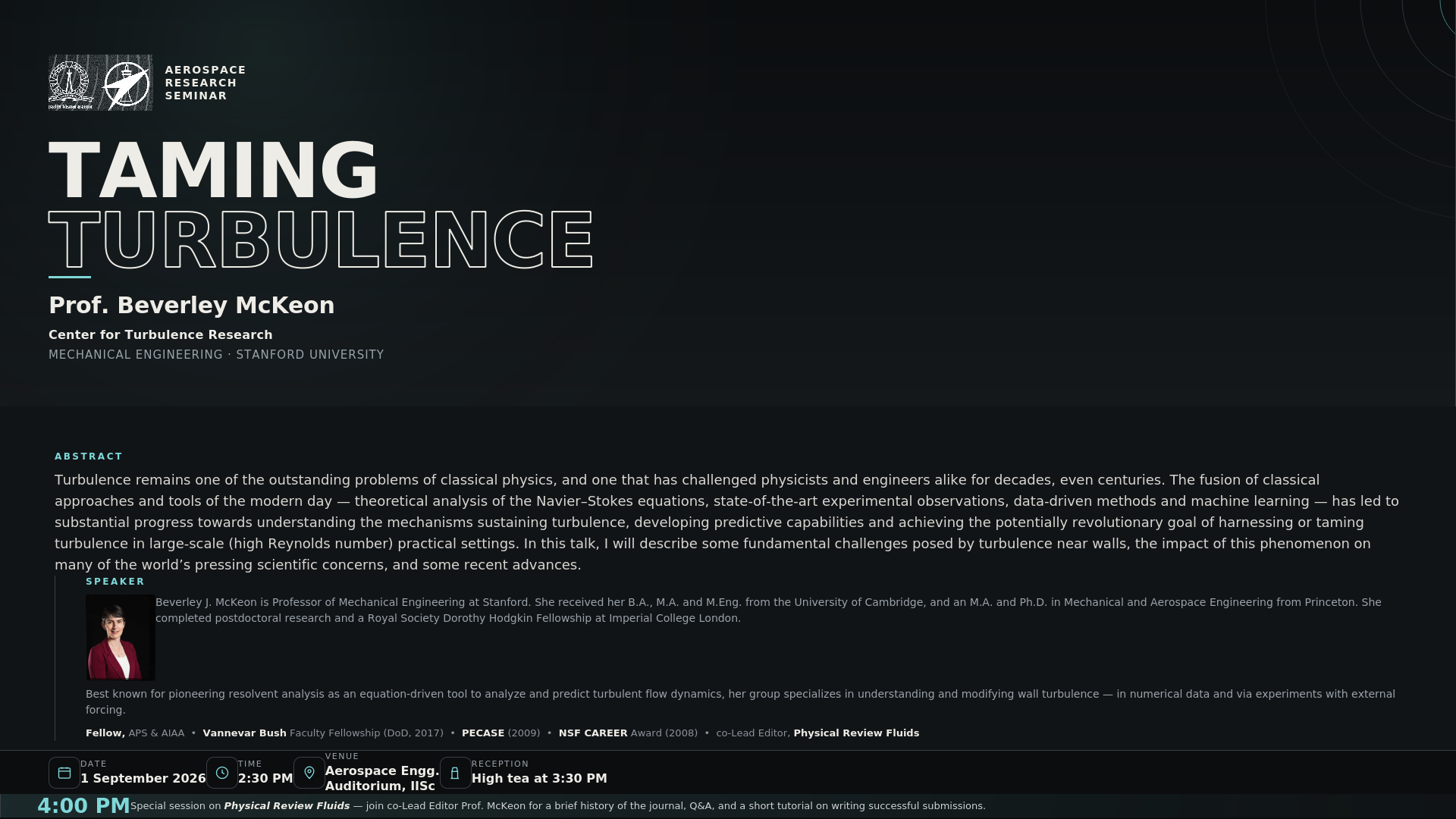
Taming Turbulence

Auditorium (AE 005), Department of Aerospace Engineering

Turbulence remains one of the outstanding problems of classical physics, and one that has challenged physicists and engineers alike for decades, even centuries. The fusion of classical approaches and tools of the modern day – theoretical analysis of the Navier-Stokes equations, state-of-the-art experimental observations, data-driven methods and machine learning – has led to substantial progress […]

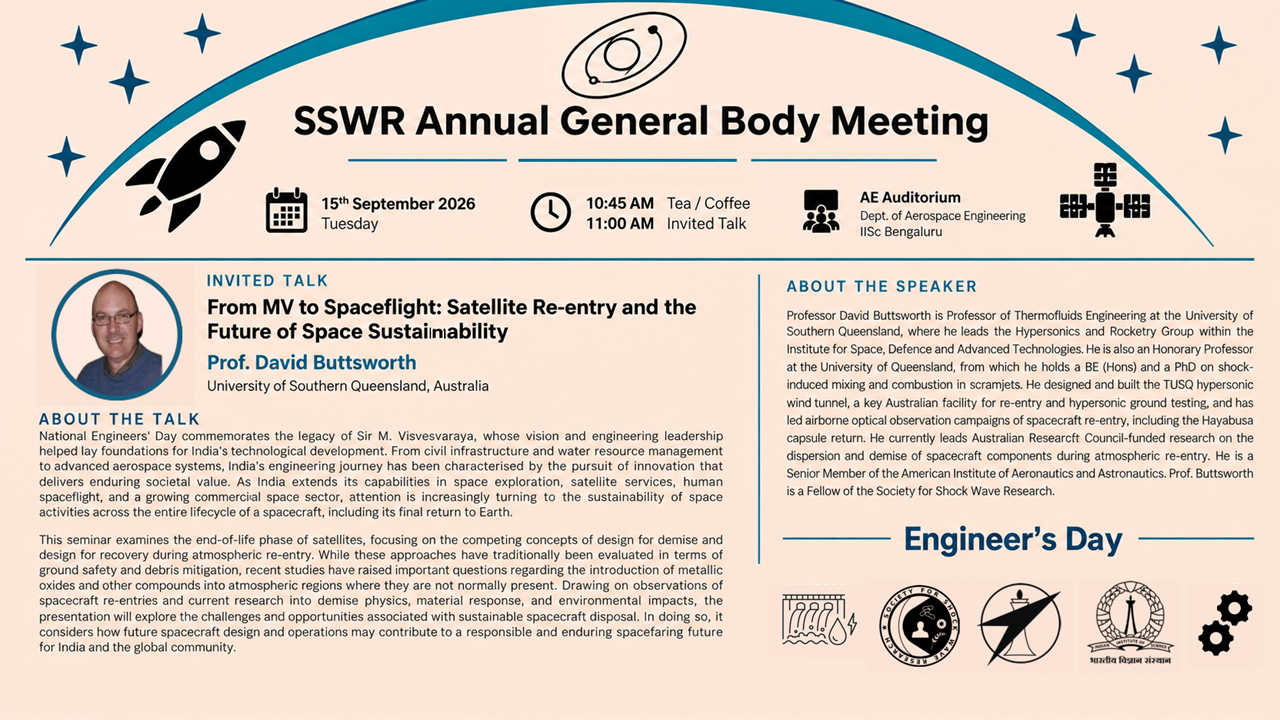
Invited Talk on the Occasion of the Engineer’s Day – From MV to Spaceflight: Satellite Re-entry and the Future of Space Sustainability

Auditorium (AE 005), Department of Aerospace Engineering

National Engineers' Day commemorates the legacy of Sir M. Visvesvaraya, whose vision and engineering leadership helped lay foundations for India's technological development. From civil infrastructure and water resource management to advanced aerospace systems, India's engineering journey has been characterised by the pursuit of innovation that delivers enduring societal value. As India extends its capabilities in […]

Illuminating Complex Flows: Optical Diagnostics for Aerospace Applications

Auditorium (AE 005), Department of Aerospace Engineering

Hypersonic flight represents a major frontier in aerospace engineering, with its realization requiring a fundamental understanding of coupled chemical and fluid dynamic processes across multiple environments. Of particular importance are the reacting flows within the propulsion systems that enable sustained hypersonic flight and the high-temperature, chemically reacting flows that develop near vehicle surfaces at extreme […]

Ph.D. (Engg): Development of Learning-based Strategies for Reconnaissance with Multi-Robot Systems

STC Seminar Hall, Dept. of Aerospace Engineering
Virtual Event Virtual Event

Reconnaissance is the contest for information about a territory: one side tries to observe an asset or a guarded area, the other tries to deny it. Low-cost drones have made this contest cheap and constant, and protecting critical infrastructure against it is now a crucial problem, because an intruder no longer needs to strike a […]

Magneto-Active Solids for Adaptive Structures: Can Magnetic Fields Control Elastic Waves?

Magneto-active solids couple their mechanical response to externally applied magnetic fields, providing a promising route toward remotely tunable materials and structures. Such functionality is particularly attractive for aerospace applications involving vibration isolation, adaptive structures, sensing, and elastic-wave control. However, exploiting this coupling requires understanding a fundamental question: when does a magnetic field actually modify elastic-wave […]

Ph.D. (Engg): A Slotted Wing Configuration for STOL Applications

Online
Virtual Event Virtual Event

The rapid development of Urban Air Mobility (UAM) has led to the emergence of electric vertical take-off and landing (eVTOL) aircraft, with many current concepts relying on tilt-rotor or other complex propulsion-conversion mechanisms to achieve vertical take-off and landing followed by efficient forward flight. While these configurations provide the required operational flexibility, the mechanical complexity […]

Ph.D. (Engg): Splashing of impacting drops on rigid and flexible superhydrophobic surfaces

STC Seminar Hall, Dept. of Aerospace Engineering

Understanding droplet impact dynamics on superhydrophobic (SHP) surfaces is crucial for exploiting their exceptional liquid-repellent properties in various industrial applications. Studies on high-velocity droplet impacts on SHP surfaces, particularly under splashing conditions, are of significant importance for applications such as anti-icing and erosion protection of turbine blades. This thesis presents an experimental investigation of splashing […]

M.Tech (Res): Direct Numerical Simulation of Turbulent Aerosol Transport in Human Respiratory Flows

AE Conference Room , AE 003
Virtual Event Virtual Event

Airborne transmission of respiratory diseases is governed by the coupled dynamics of the exhaled turbulent flow and the transport of pathogen-laden aerosols and droplets. This thesis studies two representative respiratory activities, speech and cough, and quantifies the infection probability using Direct Numerical Simulations. The incompressible Boussinesq Navier-Stokes equations are solved using Megha-5 solver, including the […]

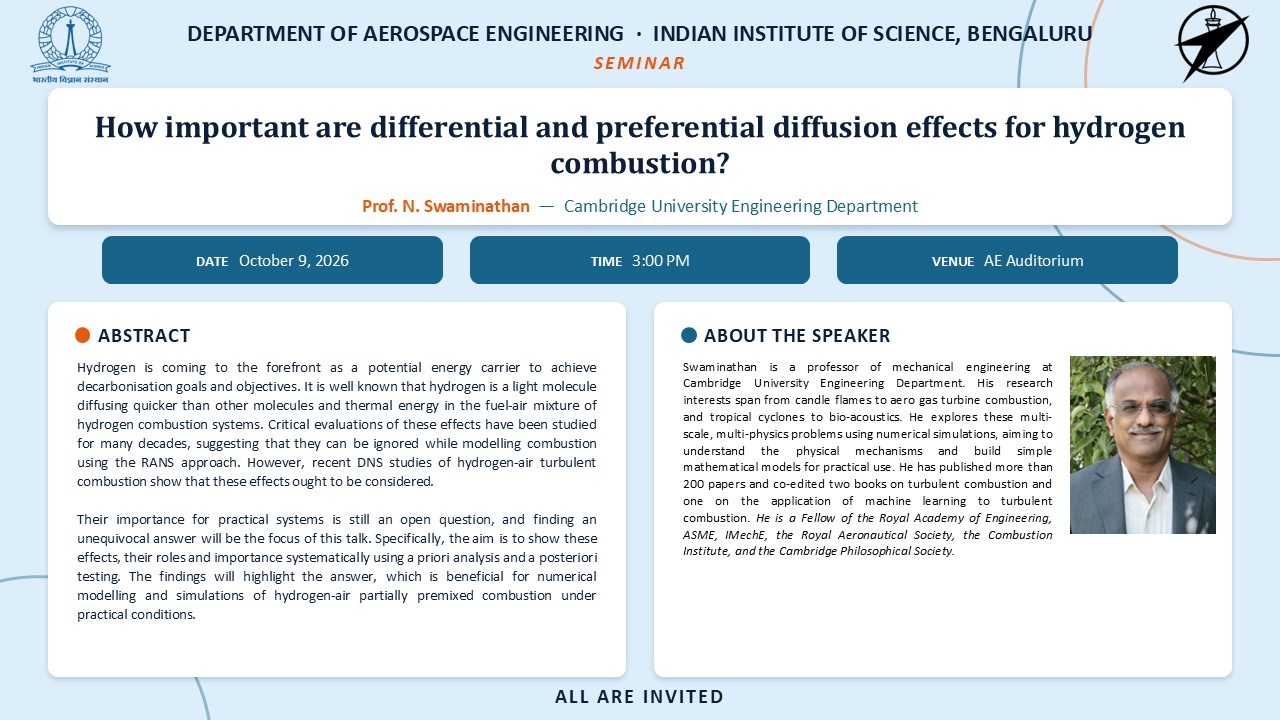
How important are differential and preferential diffusion effects for hydrogen combustion?

Auditorium (AE 005), Department of Aerospace Engineering

Hydrogen is coming to the forefront as a potential energy carrier to achieve decarbonisation goals and objectives. It is well known that hydrogen is a light molecule diffusing quicker than other molecules and thermal energy in the fuel-air mixture of hydrogen combustion systems. Critical evaluations of these effects have been studied for many decades, suggesting […]

Ph.D. (Engg): Acoustic Black Holes and Architected Designs for Vibration and Wave Control in Composite and Sandwich Structures

AE Conference Room , AE 003
Virtual Event Virtual Event

Lightweight composite panels and sandwich structures are vital in aerospace and mechanical engineering due to their high stiffness-to-weight ratios. However, minimizing structural mass often compromises dynamic performance, leading to severe issues like excessive vibration, noise transmission, flutter, and uncontrolled wave propagation. This research investigates the integration of acoustic black holes (ABHs) as a passive mechanism […]

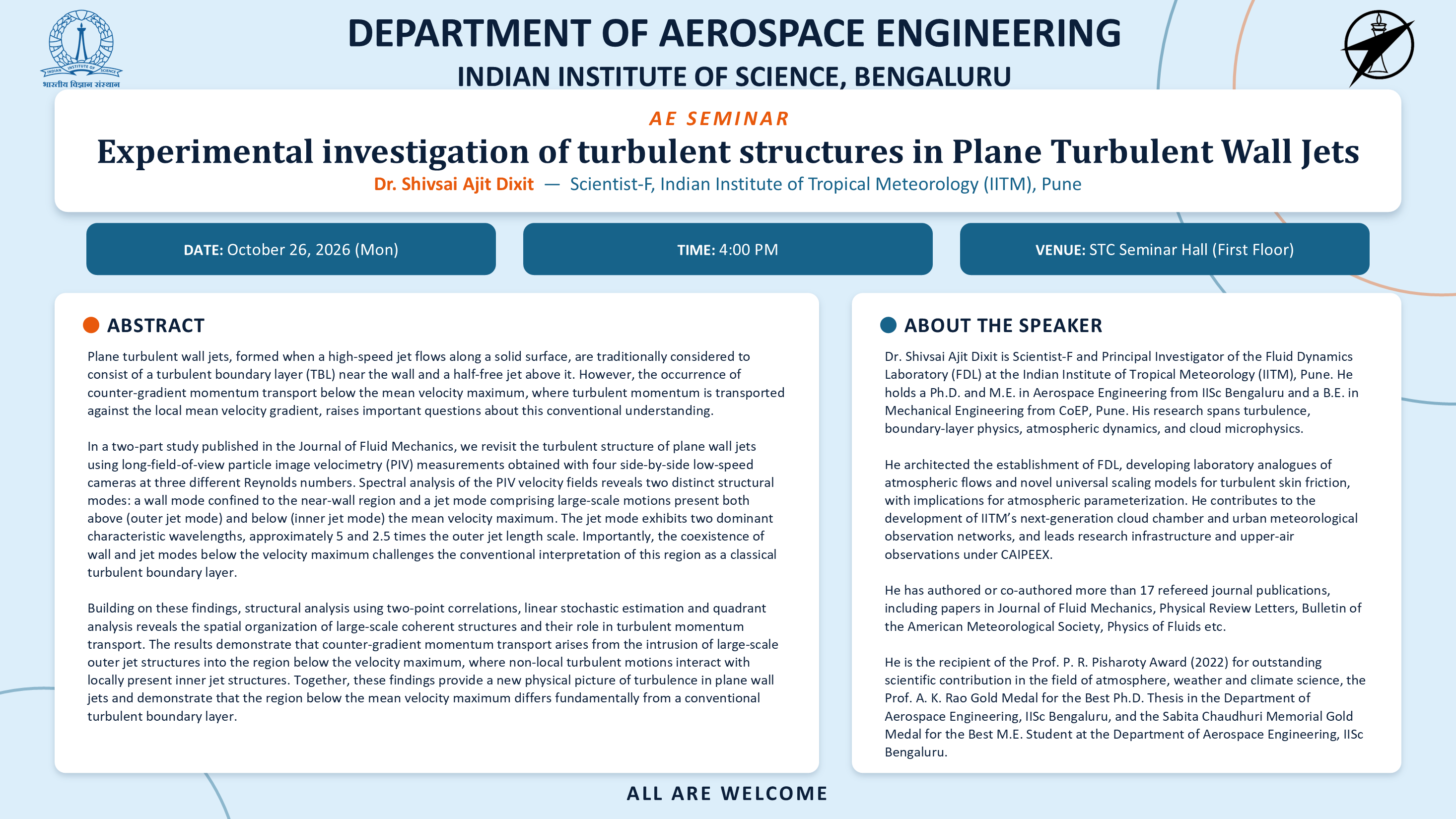
Experimental investigation of turbulent structures in Plane Turbulent Wall Jets

STC Seminar Hall, Dept. of Aerospace Engineering

Plane turbulent wall jets, formed when a high-speed jet flows along a solid surface, are traditionally considered to consist of a turbulent boundary layer (TBL) near the wall and a half-free jet above it. However, the occurrence of counter-gradient momentum transport below the mean velocity maximum, where turbulent momentum is transported against the local mean […]

Scroll to Top