AE Seminar

  1. Events
  2. AE Seminar

Views Navigation

Event Views Navigation

Today

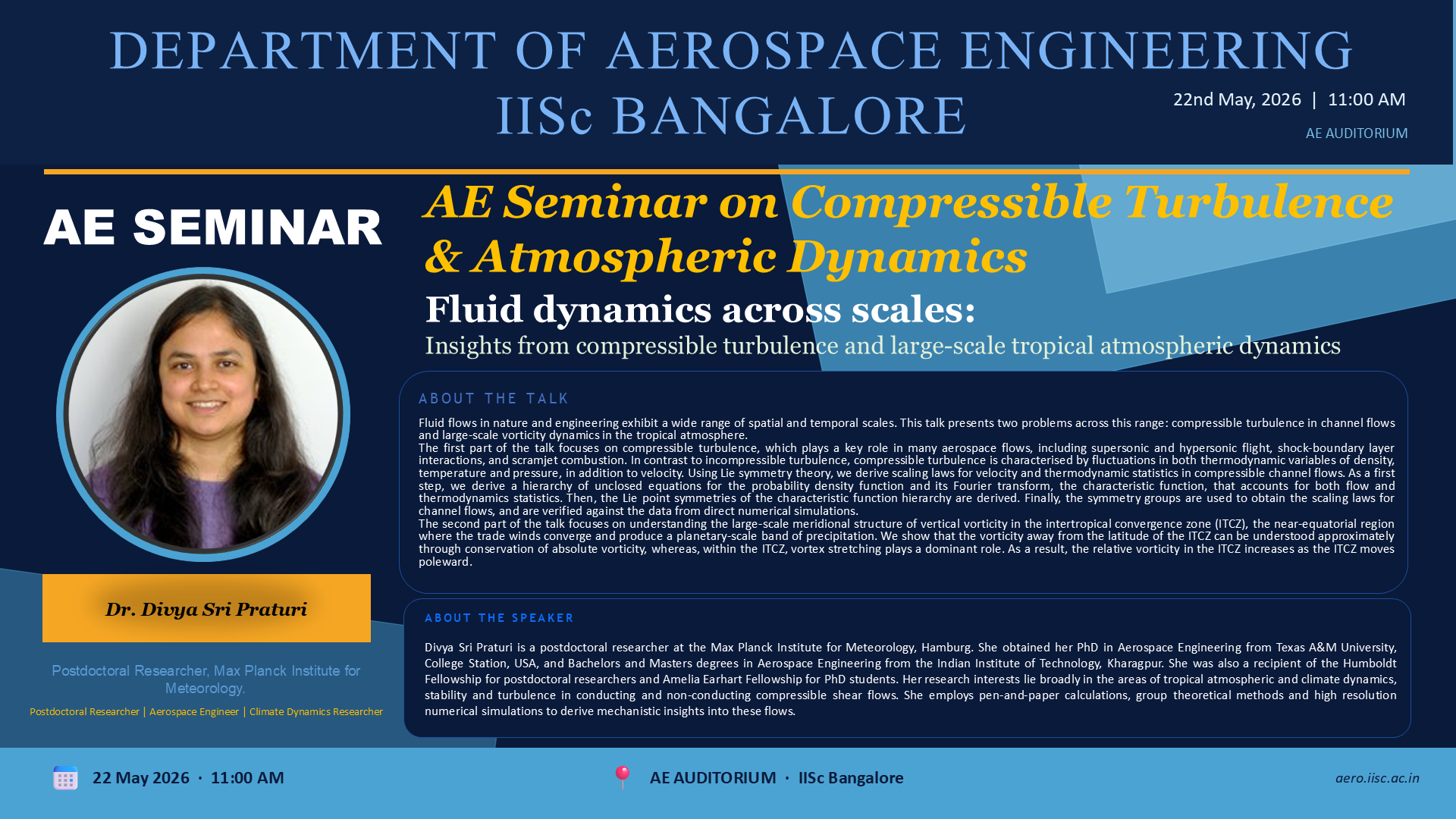
Fluid dynamics across scales: Insights from compressible turbulence and large-scale tropical atmospheric dynamics

Auditorium (AE 005), Department of Aerospace Engineering

Fluid flows in nature and engineering exhibit a wide range of spatial and temporal scales. This talk presents two problems across this range: compressible turbulence in channel flows and large-scale vorticity dynamics in the tropical atmosphere. The first part of the talk focuses on compressible turbulence, which plays a key role in many aerospace flows, […]
Deception and Risk-Sensitive Behaviors in Games with Asymmetric Information: A Pursuit-Evasion Case Study

Online
Hybrid Hybrid Event

Abstract: Games with asymmetric information involve situations where one player possesses knowledge that the other player does not. This is particularly evident in military engagements, where the “fog of war” plays a critical role in the decision-making process. In such scenarios, two distinct behaviors can be observed. The more informed player tends to adopt deceptive […]

AE Seminar by Dr Sri Prakash Sarathy, Northrop Grumman

Auditorium (AE 005), Department of Aerospace Engineering

AI in general and Agentic AI Frameworks in particular have begun to appear in safety critical and mission critical application of autonomous systems. Assurance of their behavior lags behind in terms of principles, tools and engineering practice. In this presentation I will cover some emerging approaches that are both powerful and practical, and easily understood […]

From Pilot Workload to Adverse Couplings: Understanding Human–Vehicle Interactions in Challenging Rotorcraft Operations

Auditorium (AE 005), Department of Aerospace Engineering

As civil and military aircraft evolve toward increasingly complex designs and intelligent systems, understanding pilot–vehicle interactions and their impact on safety and performance remains essential. Rotorcraft shipboard landing is among the most demanding flight operations, requiring pilots to contend with degraded and rapidly changing visual cues, deck motion, and environmental disturbances, often resulting in elevated […]

Characterizing Dynamic Response of Structures and Materials under Extreme Loading Environments

Online
Virtual Event Virtual Event

Protective structures and vessels used in marine and defense applications are increasingly required to withstand extreme dynamic loading caused by explosions in air and underwater. Designing lightweight yet resilient structures demands a fundamental understanding of shock-wave interactions with materials, structural geometry, and the surrounding medium. This seminar presents a series of experimental investigations that progressively […]

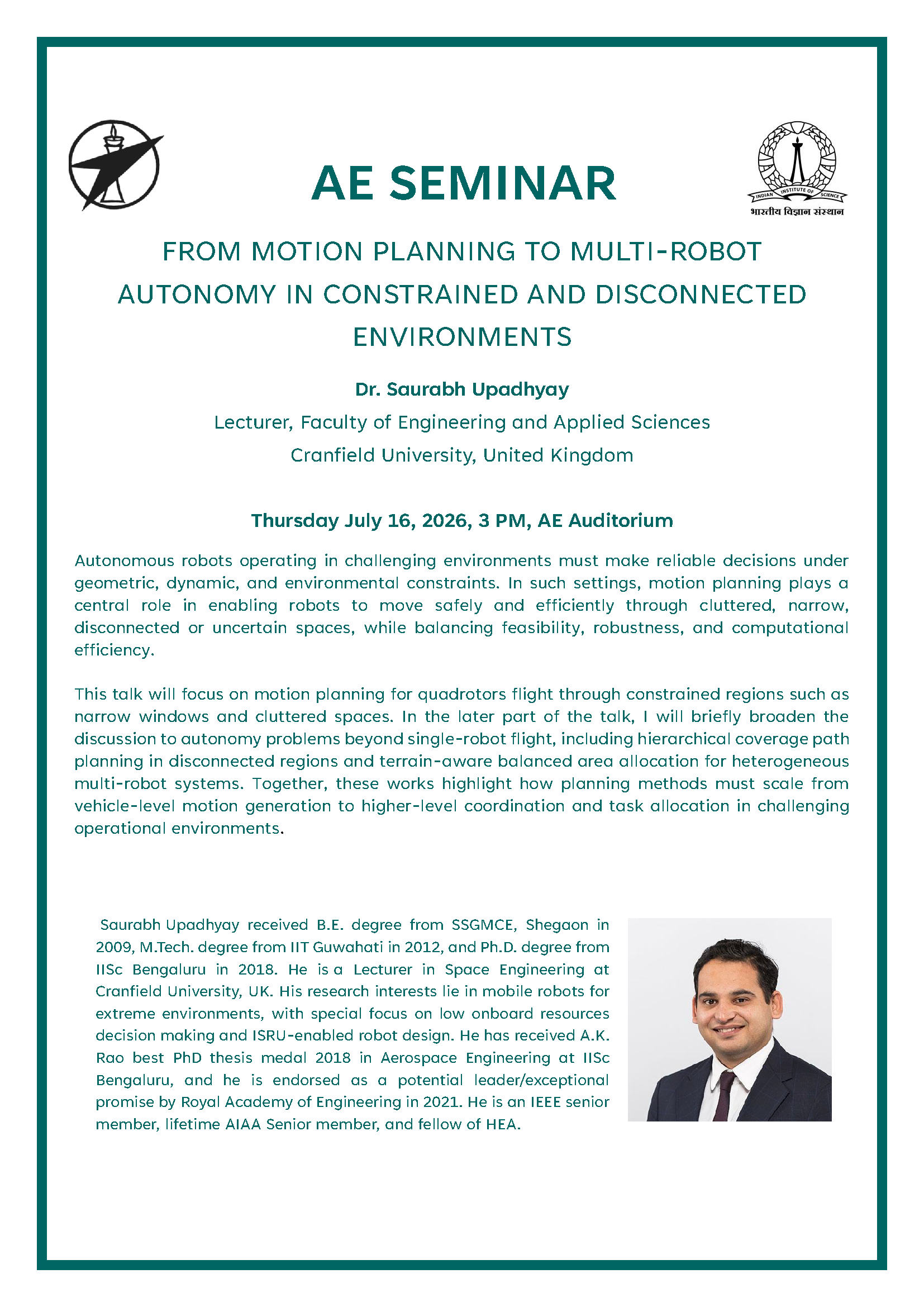
FROM MOTION PLANNING TO MULTI-ROBOT AUTONOMY IN CONSTRAINED AND DISCONNECTED ENVIRONMENTS

Auditorium (AE 005), Department of Aerospace Engineering

Autonomous robots operating in challenging environments must make reliable decisions under geometric, dynamic, and environmental constraints. In such settings, motion planning plays a central role in enabling robots to move safely and efficiently through cluttered, narrow, disconnected or uncertain spaces, while balancing feasibility, robustness, and computational efficiency. This talk will focus on motion planning for […]

AstroNav: Autonomy for Navigating Deep Space and Beyond

STC Seminar Hall, Dept. of Aerospace Engineering

Autonomous navigation is becoming a critical capability for modern deep space exploration, planetary defense, and commercial space ventures. Traditional spacecraft navigation relies heavily on ground-based radio contact to collect two-way radiometric Doppler and range measurements. However, this structural dependency introduces significant communication latency and places a heavy burden on oversubscribed ground antenna networks. For cutting-edge […]

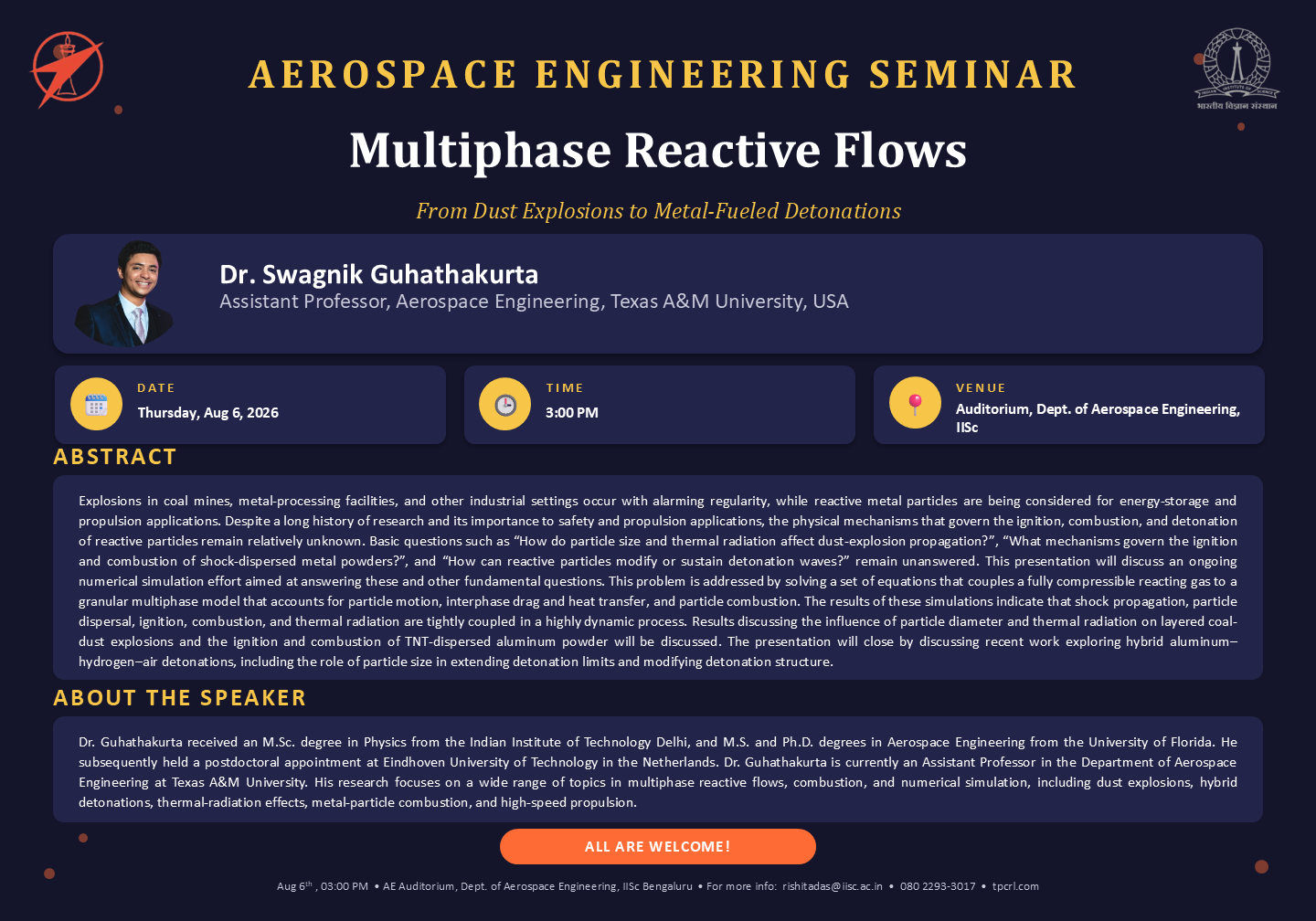
Multiphase Reactive Flows: From Dust Explosions to Metal-Fueled Detonations

Auditorium (AE 005), Department of Aerospace Engineering

. Explosions in coal mines, metal-processing facilities, and other industrial settings occur with alarming regularity, while reactive metal particles are being considered for energy-storage and propulsion applications. Despite a long history of research and its importance to safety and propulsion applications, the physical mechanisms that govern the ignition, combustion, and detonation of reactive particles remain […]

Ph.D. (Engg):Effect of rotation on the flow organisation and instability of a slender spinning body across quiescent, axial and compressible regimes

STC Seminar Hall, Dept. of Aerospace Engineering
Virtual Event Virtual Event

A body of revolution spinning in a fluid drives an inherently three-dimensional boundary layer, in which a centrifugally driven secondary circulation lifts the layer off the surface and a centrifugal instability carries it into transition. Most of what is known about this flow comes from single geometries (the rotating disk, the isolated cone or cylinder) […]

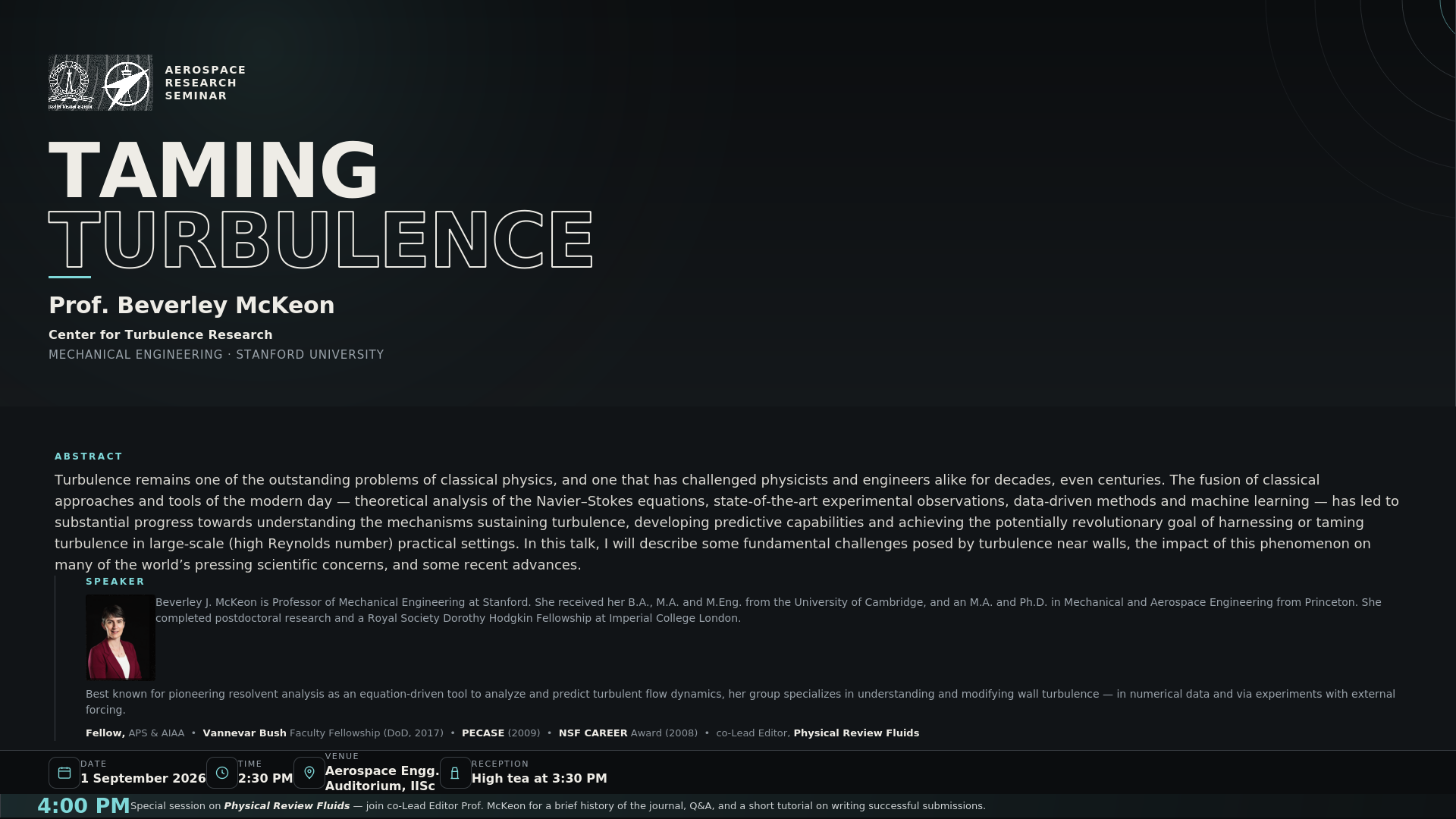
Taming Turbulence

Auditorium (AE 005), Department of Aerospace Engineering

Turbulence remains one of the outstanding problems of classical physics, and one that has challenged physicists and engineers alike for decades, even centuries. The fusion of classical approaches and tools of the modern day – theoretical analysis of the Navier-Stokes equations, state-of-the-art experimental observations, data-driven methods and machine learning – has led to substantial progress […]

Illuminating Complex Flows: Optical Diagnostics for Aerospace Applications

Auditorium (AE 005), Department of Aerospace Engineering

Hypersonic flight represents a major frontier in aerospace engineering, with its realization requiring a fundamental understanding of coupled chemical and fluid dynamic processes across multiple environments. Of particular importance are the reacting flows within the propulsion systems that enable sustained hypersonic flight and the high-temperature, chemically reacting flows that develop near vehicle surfaces at extreme […]

Magneto-Active Solids for Adaptive Structures: Can Magnetic Fields Control Elastic Waves?

Magneto-active solids couple their mechanical response to externally applied magnetic fields, providing a promising route toward remotely tunable materials and structures. Such functionality is particularly attractive for aerospace applications involving vibration isolation, adaptive structures, sensing, and elastic-wave control. However, exploiting this coupling requires understanding a fundamental question: when does a magnetic field actually modify elastic-wave […]

Scroll to Top