

How important are differential and preferential diffusion effects for hydrogen combustion?
October 9 @ 3:00 PM - 5:00 PM
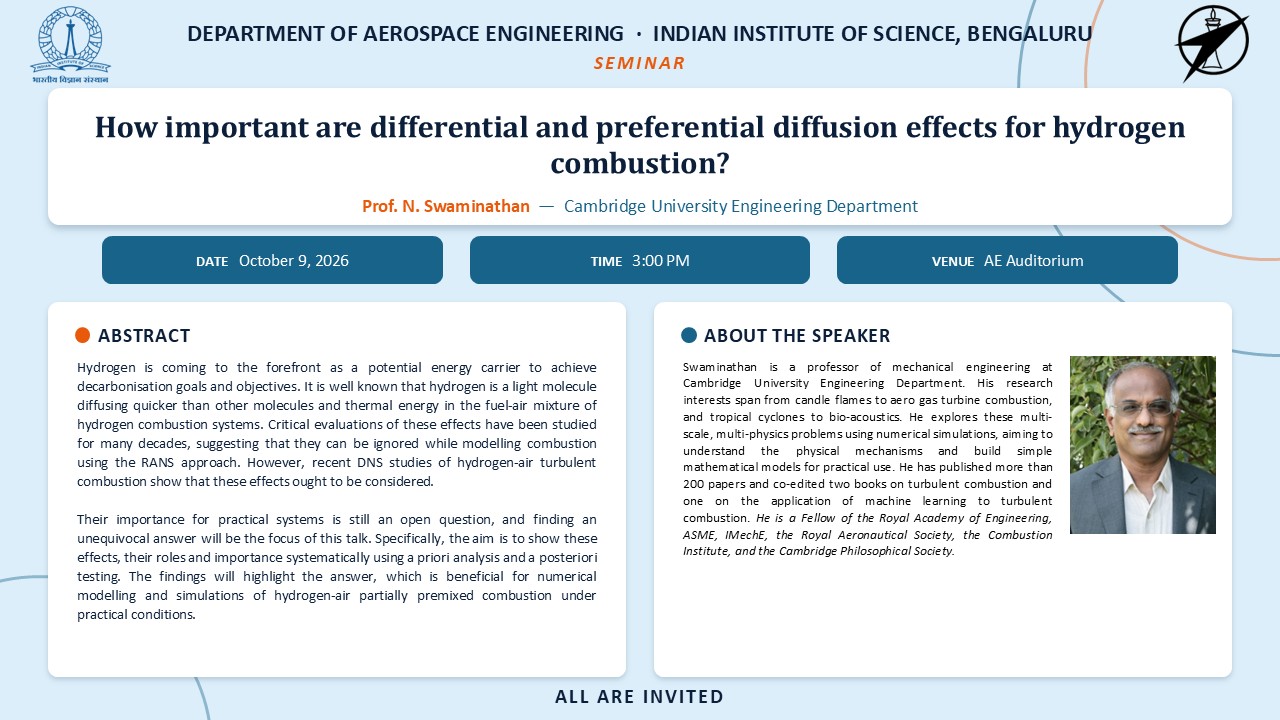
Hydrogen is coming to the forefront as a potential energy carrier to achieve decarbonisation goals and objectives. It is well known that hydrogen is a light molecule diffusing quicker than other molecules and thermal energy in the fuel-air mixture of hydrogen combustion systems. Critical evaluations of these effects have been studied for many decades, suggesting that they can be ignored while modelling combustion using the RANS approach. However, recent DNS studies of hydrogen-air turbulent combustion show that these effects ought to be considered.
Their importance for practical systems is still an open question, and finding an unequivocal answer will be the focus of this talk. Specifically, the aim is to show these effects, their roles and importance systematically using a priori analysis and a posteriori testing. The findings will highlight the answer, which is beneficial for numerical modelling and simulations of hydrogen-air partially premixed combustion under practical conditions.
Speaker: Prof. N. Swaminathan
Biography:
Swaminathan is a professor of mechanical engineering at Cambridge University Engineering Department. His research interests span from candle flames to aero gas turbine combustion and tropical cyclones to bio-acoustics. He explores these multi-scale and multi-physics problems using numerical simulations with the aim to understand the physical mechanisms and to build simple mathematical models for practical use. He has published more than 200 papers and has co-edited two books on turbulent combustion and one on application of machine learning to turbulent combustion. He is a Fellow of Royal Academy of Engineering, ASME, IMechE, Royal Aeronautical Society, Combustion Institute and Cambridge Philosophical Society.